
Poor health isn’t just a wellbeing concern – it’s a silent financial drain. Across the UK, preventable conditions like smoking, obesity and high blood pressure are quietly costing businesses thousands per employee every year. For HR and wellbeing leaders, understanding these costs is key to protecting both performance and profit.
Health and productivity: The missing link
Wellbeing conversations often focus on culture, morale or retention. While important, they can overshadow a more measurable issue: the productivity loss caused by poor health.
This loss shows up in three ways:
- Absenteeism: employees missing work due to illness.
- Presenteeism: employees at work but performing below capacity.
- Lifestyle risks: habits that fuel both absenteeism and presenteeism.
Alone, each may seem manageable. Together, they form a silent drain on business performance that most organisations underestimate.
The financial reality
The evidence is clear: poor health costs time, and time costs money.
Smoking
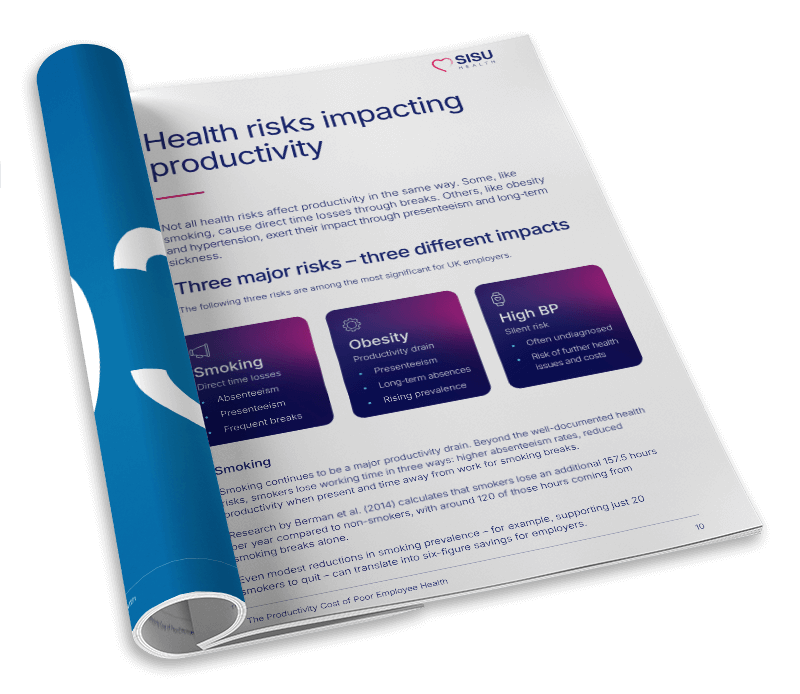
Research by Berman et al. (2014) found that “smokers lose an additional 157.5 hours per year compared to non-smokers,” with much of that time accounted for by smoking breaks.
At £20 per hour, that’s a loss of more than £3,000 per employee each year.
Obesity
According to Finkelstein et al. (2010), employees with obesity lose between “29 and 240 hours of productivity per year, depending on severity and gender.”
Even at the lower end of the scale, that equates to around £2,400 per employee annually.
High blood pressure
Hypertension is often described as a “silent killer,” but it’s also a silent productivity drain.
Unmuessig et al. (2016) estimate that employees with high blood pressure lose 15.1 hours of productivity per year, equivalent to around £300 each.
Individually, these losses may seem manageable. But when multiplied across a workforce, the numbers rapidly escalate into hundreds of thousands – even millions – in lost productivity every year.
Benchmarking the cost of poor health
To put this into perspective, here’s what the annual productivity cost looks like per 100 employees, based on UK workforce prevalence rates and an average hourly cost of £20:
| Health Risk | Prevalence | Hours Lost | Annual Cost |
|---|---|---|---|
| Smoking | 13.1% | 157.5 | £41,265 |
| Obesity | 28.5% | ~120 | £68,400 |
| High BP | 13.1% | 15.12 | £3,930 |
Source: SISU Health analysis, drawing on Berman et al. (2014), Finkelstein et al. (2010) and Unmuessig et al. (2016).
Stop losing £3,000+ per employee each year
Discover hidden workforce health costs and get a ready-to-use guide to build a business case for prevention.
Why this matters for HR teams
Putting a pound value on health risks transforms the conversation. Instead of advocating for wellbeing initiatives on engagement or culture alone, HR teams can present hard evidence of measurable costs – and show how prevention delivers tangible ROI.
Even modest improvements make a difference. Reducing obesity prevalence by just 5-10% can return hundreds of thousands in recovered productivity, turning “nice-to-have” health programs into strategic imperatives.
From insight to action
The good news? These costs are avoidable. Simple steps can make a big difference:
- Workforce health screenings to uncover hidden risks.
- Benchmarking against industry averages to see if your workforce is overexposed.
- Targeted interventions – including smoking cessation programs, weight management and blood pressure support.
- Tracking improvements over time to prove ROI to leadership.
How much is poor health costing your business?
Our new e-Book, The Productivity Cost of Poor Health: A Blueprint for Building Your Business Case, gives HR and wellbeing leaders the data, tools and frameworks to take action.
Inside, you’ll find:
- UK benchmarks for smoking, obesity, and high blood pressure
- Simple formulas to estimate your current productivity loss
- A business case framework to present to senior stakeholders
Key takeaways
- Poor health can cost £3,000+ per employee annually.
- The biggest risks are smoking, obesity and high blood pressure.
- Quantifying these costs provides evidence to secure investment.
- Even small improvements deliver six-figure savings.


Turn workforce wellbeing into measurable results
Learn how we help employers reduce hidden health costs, boost productivity and improve employee wellbeing.