
A workplace wellbeing programme may be available to all employees, but that doesn’t mean it’s accessible to all. When support fails to reach the whole workforce, employees can be left behind, and employers are left without a complete picture of workforce health. Discover how to identify gaps, uncover hidden health risks and build a more inclusive wellbeing programme.
The difference between provision and reach
Most organisations already invest in workplace health and wellbeing support, reflecting the recognised link between workforce health and organisational performance.
But are the employees most likely to benefit from support actually able to access it?
According to the Chartered Institute of Personnel and Development (CIPD), 69% of organisations provide occupational health services, rising to 86% among larger organisations. But that doesn’t guarantee everyone can access them.
For operational and manual workers who are often spread across multiple sites, working rotating shifts or with limited desk access, practical barriers can make support difficult to access despite being readily available. This creates an access gap.
Westfield Health found that one in three manual workers reported having no wellbeing support at work. This could reflect a lack of provision, limited awareness or difficulties accessing the support available.
Closing that gap requires organisations to look beyond what’s available and understand who is actually being reached.
A lack of accessibility can create blind spots
When barriers exist, employees may be less able to engage, conditions go unidentified and opportunities for early intervention are missed. Over time, these unaddressed health risks can affect workforce wellbeing and wider organisational performance.
For employees, this can mean missing opportunities to better understand and manage their health. Without clear routes into support, many people may not discover a risk until it has already begun to affect their wellbeing.
For employers, the effects extend beyond individual health outcomes. Undetected health risks can contribute to higher absence rates, reduced productivity and an incomplete picture of health needs across the workforce.
It can also lead to hidden financial strain. Illustrative modelling using the prevalence of smoking and high blood pressure in SISU Health’s workplace data, alongside published estimates of the associated productivity costs, suggests that these risks could be associated with approximately £1.7 million in annual lost productivity for a workforce of 1,500 employees. This is a modelled estimate rather than a directly observed cost and will vary according to the health profile of each workforce. The calculation uses productivity cost modelling published by Berman et al. (2014) and Unmuessig et al. (2016).
When support isn’t accessible, health risks remain hidden until they become workforce risks.
A workplace health programme can’t improve the health of employees it doesn’t reach.
Four measures of an inclusive wellbeing programme
Understanding whether a workplace wellbeing programme is accessible goes beyond measuring participation numbers.
To assess if support is reaching all employees and improving outcomes, employers need to examine the full journey, from engagement through to long-term impact.
Each measure should also be examined by site, role, working pattern and other relevant workforce characteristics. Overall results can otherwise conceal significant differences in access and outcomes between groups.
Reach – Are you seeing all employees?
Participation is often one of the first metrics employers look at when evaluating a workplace health programme. However, strong overall engagement doesn’t mean it is reaching the whole workforce.
To better understand reach, employers should look beyond participation figures and consider whether engagement reflects the workforce they’re trying to support.
Employers should ask:
- Which people are engaging? – An inclusive programme must engage more than the people based in head office, reaching employees across multiple sites and operational settings.
- Are employees across all shift patterns participating? – If support is only available at certain times of day, or on limited dates, this creates a barrier to access.
- Which employees are not engaging? – Understanding who is missing from the data can be just as important as understanding who is represented within it.
A programme cannot provide an accurate picture of workforce health if it only reaches the people easiest to engage. Accessibility is the foundation that turns participation into meaningful insight.

Discover how this framework works in practice
Watch SISU Health and Kier Group explore how organisations can reach operational and safety-critical workers across different sites, roles and working patterns.
Risk – What health risks are being identified?
An inclusive workplace wellbeing programme should help employers understand the health risks that exist across their workforce. However, it can only identify risks among the employees it reaches.
SISU Health’s workforce health data indicates that:
- 14.2% of operational and manual workers recorded high blood pressure.
- 65.1% of operational and manual workers were classified as overweight or obese.
These findings demonstrate how accessible workplace health programmes can help to uncover risks that might otherwise go unidentified.
Without reliable workforce health data, organisations may be unaware of the prevalence of specific health risks or the groups most affected by them. This is where wellbeing programmes begin to provide meaningful insight.
Breaking these insights down by site, role and working pattern can help employers understand where particular risks may be more prevalent and where targeted support is most needed.
Action – What happens after a risk is identified?
What takes a wellbeing programme from insight to impact is what happens after a risk has been identified.
According to SISU Health’s workforce health data, 18.6% of health checks completed by operational and manual workers resulted in a recommendation to seek GP follow-up. This highlights the importance of ensuring employees not only understand the risks identified but also know what steps to take next.
For a dispersed workforce working across multiple sites, locations and shift patterns, accessing follow-up support is not always straightforward. An inclusive wellbeing programme should therefore provide clear and practical pathways into appropriate support.
Whether that means seeking GP follow-up, accessing workplace wellbeing services or receiving other forms of support, employees should understand what action to take and how to access it.
Change – Is the programme leading to positive outcomes?
The ultimate measure of an inclusive workplace wellbeing programme is whether it leads to meaningful change.
When access to wellbeing support is straightforward, the results can be significant.
Analysis of 39,183 operational and manual workers who completed repeat health checks found that the recorded prevalence of high blood pressure was 25.5% lower and smoking prevalence was 17.4% lower at subsequent measurements than at the initial measurement. These findings show improvements in the recorded health indicators among repeat users, although the analysis cannot determine what caused those changes.
For employers, these findings indicate that repeat engagement can provide insight beyond initial awareness. When employees identify risks, access appropriate support and return for further checks, changes in workforce health measures can be monitored over time.
Ultimately, the most inclusive workplace wellbeing programmes are measured not by participation alone, but by who they reach and the outcomes they help achieve.
A quick test for employers
A workplace wellbeing programme may be available to everyone on paper, but is it accessible to everyone?
Ask yourself these questions:
- Are we reaching employees across all sites and roles?
- Do we know who isn’t engaging and why?
- Is it easy for employees to access help once a risk has been identified?
- Can we demonstrate measurable improvements in health outcomes over time?
If the answer to any of these questions is “no” or unclear, there may be opportunities to improve the accessibility of your wellbeing programme.
By addressing these gaps, organisations can move workplace wellbeing from a nice-to-have initiative to an integrated programme that delivers meaningful outcomes for both employees and employers.
Key takeaways
- An inclusive wellbeing programme reaches more than just the employees who are easiest to engage.
- Health insights create value when employees can access and act on appropriate support.
- Meaningful outcomes come from ongoing engagement, not one-off interventions.
- The most effective programmes measure outcomes, not just participation.
Next steps
- Watch the ‘Making Workplace Health Inclusive for Operational and Safety-Critical Workers’ webinar – Discover how to deliver a workplace wellbeing strategy that is fit for purpose.
- Read the Currys case study – Read how an inclusive wellbeing strategy was delivered across a dispersed frontline workforce.
- Download The State of Workforce Health 2025 report – Discover how workforce health data can support strategic decision-making.
Sources
- Berman, M., Crane, R., Seiber, E., & Munur, M. (2014) Estimating the cost of a smoking employee. Tobacco Control, 23(5), 428-433. Available at: https://tobaccocontrol.bmj.com/content/23/5/428
- Chartered Institute of Personnel and Development (2025) Health and wellbeing at work. CIPD. Available at: https://www.cipd.org/uk/knowledge/reports/health-well-being-work/
- SISU Health Workforce Health Data. Analysis based on 415,717 workplace health checks completed by 238,225 operational and manual workers between 15 April 2015 and 9 September 2026. Operational and manual worker classifications were based on participant department data. Repeat-user analysis was based on 39,183 participants who completed two or more health checks, with a minimum of eight days between measurements.
- Unmuessig, V., Fishman, P.A., Vrijhoef, H. J., Elissen, A. M., & Grossman, D.C., (2016). Association of Controlled and Uncontrolled Hypertension with Workplace Productivity. Journal of Clinical Hypertension (Greenwich, Conn.), 18(3), 217-222. Available at: https://onlinelibrary.wiley.com/doi/10.1111/jch.12648
- Westfield Health (2025) Wellbeing for manual workers. Available at: https://www.westfieldhealth.com/resources/manual-workers-wellbeing

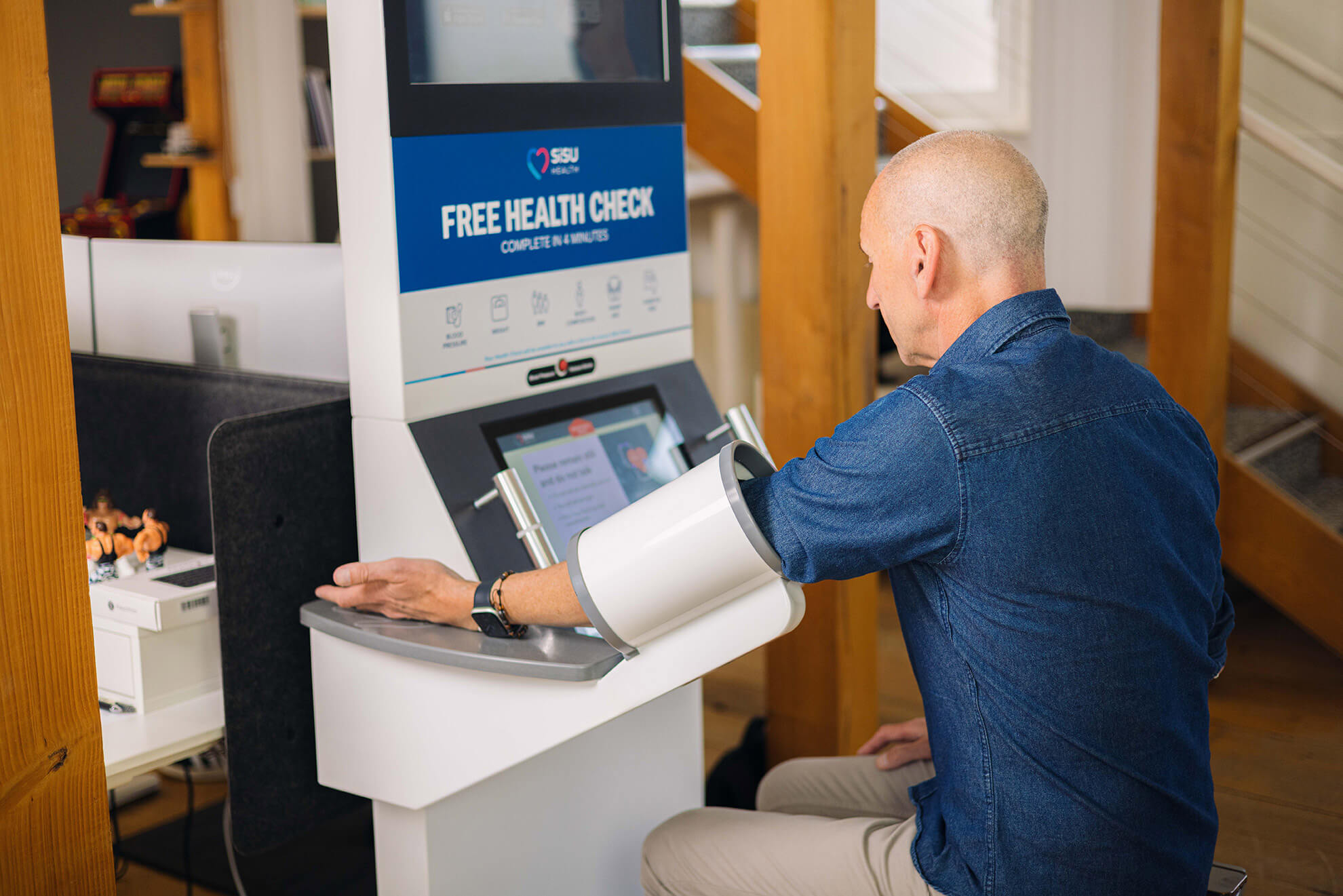
Turn workforce wellbeing into measurable results
Learn how we help employers reduce hidden health costs, boost productivity and improve employee wellbeing.