At Luton & Dunstable University Hospital, staff wellbeing support had mostly come into play once someone was already struggling. A single self-service Health Station gave the Bedfordshire Hospitals NHS Foundation Trust a way to get ahead of that – regular, objective data on its workforce’s physical health, reported to the committees responsible for it. What the data showed surprised even the person who brought it in.
When Luton Council’s public health team asked whether the hospital would host a SISU Health Station, Jennie Jones, Head of Staff Engagement, Health and Wellbeing, had one audience in mind: the Trust’s own staff.
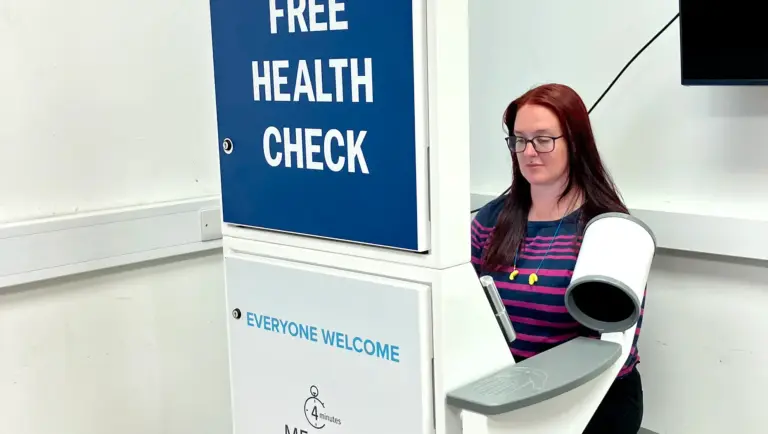
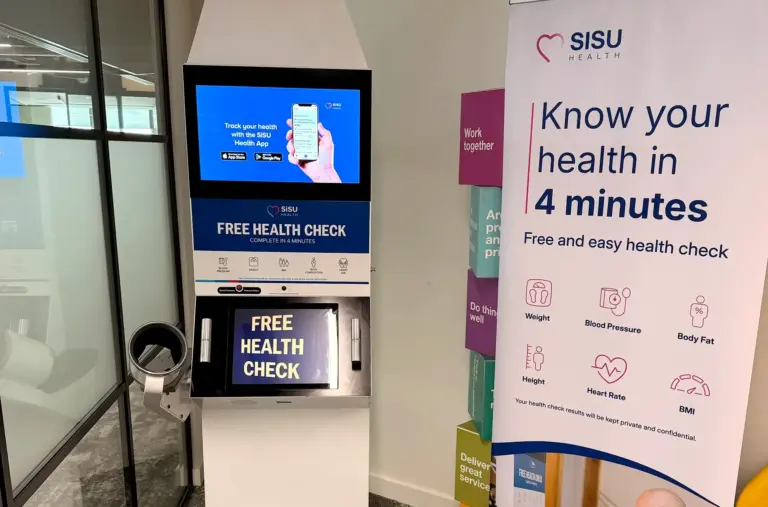
That focus hasn’t changed, but the audience has grown. Positioned in a main corridor beside the hospital’s main entrance, the station is used by patients, visitors and staff – even though it has only ever been promoted to employees.
Between 28 October 2025 and 21 October 2026, it recorded:
- 10,484 health checks from 8,660 people, including 1,002 staff
- 64.5% of users who hadn’t had a blood pressure check in the previous 12 months – 62.7% of staff users
- 23% of health checks triggering a GP call to action for high blood pressure or high BMI – 22% among staff users
The challenge – A gap in physical health prevention for around 6,000 on-site staff
Jennie explains where staff wellbeing stood before the station arrived:
While many of our offerings were focused on responding to identified needs, we recognised the opportunity to further develop our preventative approach. Our ability to do this is influenced by the availability of space, time and funding.
The support the Trust did have, including its employee assistance programme, leaned heavily towards psychological wellbeing. The bigger gap, in Jennie’s view, was physical health: exercise, weight management and healthy eating.
Her remit shaped her first thoughts, too. As the lead for staff wellbeing, she planned to ask occupational health to host the station and keep it firmly staff-facing. She also had some reservations. Years earlier, the Trust had hosted a similar machine for a month, and it hadn’t been trouble-free.
The solution – Too big for occupational health, so it went where everyone could use it
Jennie toured the hospital looking for a spot, starting close to staff: occupational health and the hospital restaurant.
Luckily the machine was too big for the very small areas that were available, which led me to looking at other options.
Opening it up to patients and visitors depended on one thing:
Once I was assured that I could obtain separate usage reports for staff from the overall usage, I was happy to look at options that would be easily accessible to all.
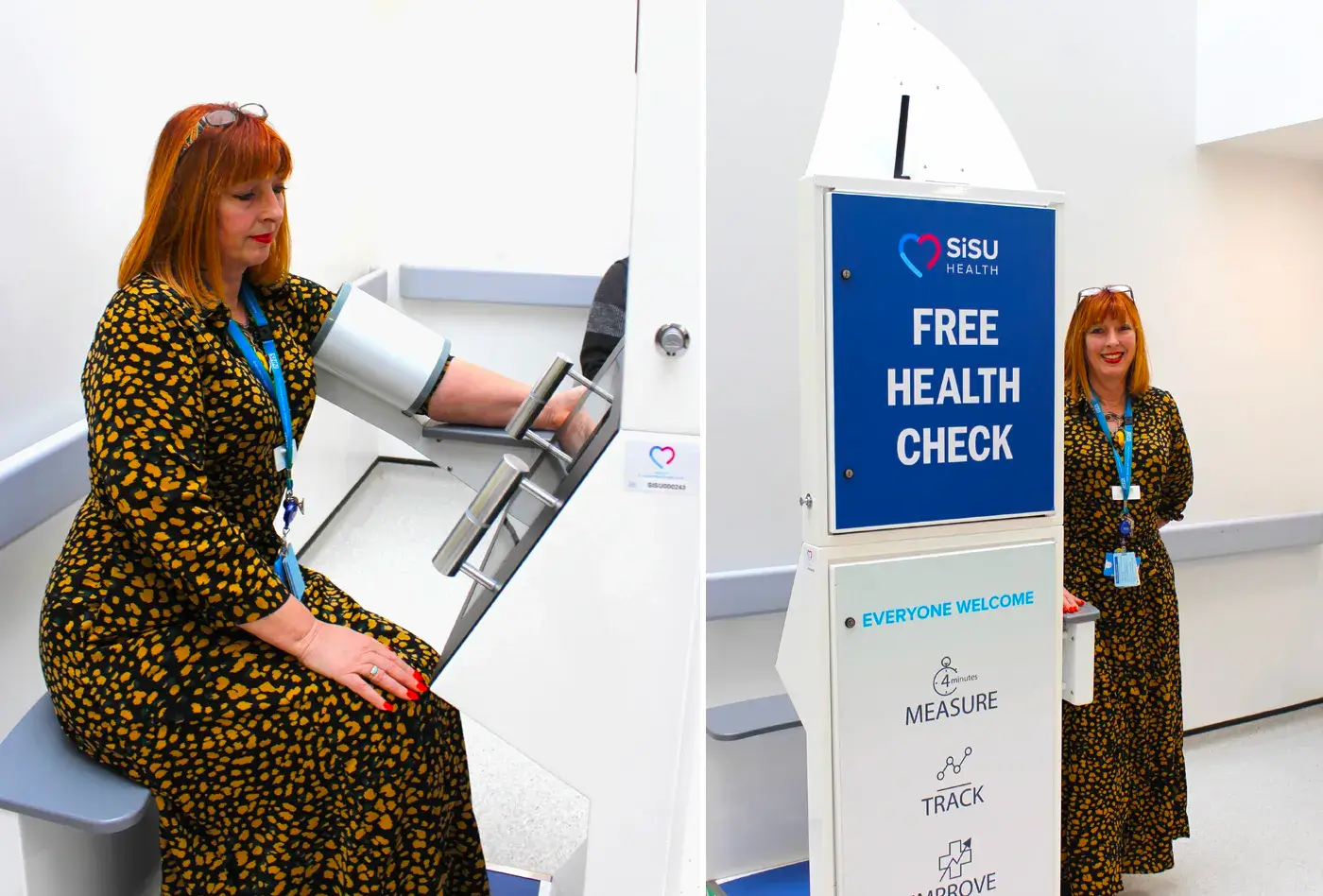
That decision put the station in a main corridor next to the main entrance, just outside A&E – a prominent, high-footfall route through the hospital. With sign-off from the Estates team and the fire officer, it was positioned so users stand with their back to a wall, keeping their results private in a busy space.
Jennie’s earlier reservations didn’t last:
It was very easy – a good relationship with SISU Health on installation requirements, and good communications.
Promoted to staff, found by everyone else
Staff hear about the station through a steady mix of channels: roughly monthly reminders in the Trust’s weekly comms email, screensavers, team briefs, meetings, the staff app and the staff Facebook page. Staff data from the station is also published on the intranet, so colleagues can see the kind of information it gathers before they try it.
Patients and visitors were never targeted. They spotted it, told each other about it, and some were pointed towards it from inside the hospital itself:
I spoke to a patient who had been directed to use the machine by a clinical member of staff.
From a corridor check to Total Wellbeing and the GP
When a check flags a potential risk, users are signposted to local wellbeing support from Total Wellbeing. Smokers who want help to quit can give permission for local services to contact them, and anyone with a result such as high blood pressure or high BMI is advised to speak to their GP.
The impact – Staff health risks that mirror the community they serve
Jennie’s verdict on the response is a balanced one:
This has exceeded my expectations… although I still want more staff to engage.
Over 1,000 staff – roughly one in six of those on site – have used the station, completing 1,534 checks alongside thousands of patients and visitors.
Jennie has also been struck by how many people keep coming back, and staff come back more than most – averaging around 1.5 checks each, compared with 1.2 across all users.
One member of staff emailed Jennie with the following message:
I just wanted to share my personal experience with the SISU Health Station. I love it! It helps me keep on target with my weight loss journey and the app helps me see the progress too. I have now lost 12kg… I hope it’s a permanent feature?
Missed checks in a building full of clinicians
The biggest surprise wasn’t a risk factor at all:
The number of participants that had not had a BP check in the previous year surprised me hugely. I thought that working in a hospital, staff have the ability to get their blood pressure checked quite easily, but it seems many do not.
The numbers back Jennie up. 62.7% of staff who used the station hadn’t had a check in the previous year (comparable to 64.5% across all users).
On the main health risks, staff results looked much like everyone else’s – with one exception:
| Staff | All users | |
|---|---|---|
| Overweight or obese | 73% | 72% |
| High blood pressure | 15.9% | 15.6% |
| Smokers | 10.7% | 17.7% |
| Health checks triggering a GP call to action | 22% | 23% |
Nearly half of staff who used the station (47%) had at least one of high blood pressure, obesity or smoking, and around one in five of those (21.2%) had two or all three.
The figure Jennie is watching most closely:
The percentage of staff with high BMI findings is a concern.
Beyond the workforce: a younger, more diverse user base
Looking across all 8,660 participants shows who the station is reaching – nearly nine in ten of them patients and visitors:
- A median age of 39 – just below the age at which people in England become eligible for an NHS Health Check
- More than half of users (55%) from Asian, Black, mixed or other ethnic backgrounds, with high BMI rising to 80% among Black users, compared with 72% overall
- A user base skewed towards more deprived areas, with a median deprivation quintile of 2
When Jennie checks on the machine each week, visitors tell her how easy it is to use, and that they come back regularly to see whether they’re improving or keeping things in check.
It’s a side of the programme Jennie never set out to deliver:
I am proud that in my role as health and wellbeing manager for staff, I have also been able to be involved in procuring this amazing piece of kit for other visitors of the Trust to use.
Strategic value – Giving workforce committees evidence, not assumptions
The separate staff reporting Jennie secured at the start is what makes the station strategically useful. It lets one station serve the whole hospital while still giving her a clear, workforce-specific view. She now reports on it regularly to the workforce committee, the people and culture operational board and the staff wellbeing involvement committee, supported by monthly reports from SISU Health’s customer success team.
That changes what those conversations can rest on. Instead of assuming hospital staff find it easy to get their blood pressure checked, the people shaping workforce support can see what’s actually happening – and track it over time.
Jennie also sees value in how the station gets people started:
Many people do find it easier to engage with a piece of equipment initially rather than approaching a professional. However, once in receipt of results that require a call to action, it may make it easier to share findings with a professional for actioning, advice or treatment.
Reaching more of the 6,000
The next goal is getting more of the Trust’s on-site workforce through the station. As for whether other hospitals should follow Luton & Dunstable’s lead, Jennie doesn’t hesitate:
I think all hospitals should have one… Just do it!
Find out what your workforce data could show you
If staff working in a hospital can go a year without a blood pressure check, what might your workforce be missing? Luton & Dunstable University Hospital only saw the gap once it could measure it.
A SISU Health Station gives you objective, workforce-specific health data – and evidence you can take to the leaders who decide what support comes next. Talk to our team to find out what it could reveal about your people.
Client Profile
Bedfordshire Hospitals NHS Foundation Trust
Bedfordshire Hospitals NHS Foundation Trust provides hospital services across Bedfordshire, incorporating Bedford Hospital and Luton & Dunstable University Hospital. Around 6,000 staff work on the Luton & Dunstable site, where the Trust’s SISU Health Station is based.
More employer success stories
Discover how employers are improving wellbeing engagement and health outcomes.




Find the health gaps your wellbeing offer can’t see
Find out how SISU Health can give you objective data on your workforce’s health – showing where risks sit, who isn’t getting checked and where to focus support.